Showing posts with label Sports. Show all posts

Thursday, November 28, 2013

TSN vs. Sportsnet

Old TSN Logo

TSN debuted in Canada in 1984, and I was immediately hooked. Suddenly we could see Blue Jays games on TV on more than just Wednesday nights and weekends, and Sportsdesk (later SportsCentre) showed highlights of the previous day's games in just about every sport. Could TV get any better than that?

That's all there was for sports TV in Canada for 14 years. In 1998, Sportsnet came along, and I basically thought of it as the poor man's TSN. They did show NHL games, but I found the sports news / highlight show was less polished than the guys over at TSN. For years, Sportsnet remained, in my mind, a distant second to TSN in terms of quality. A year later, a third station, The Score, was created, but it was mostly highlights and a score ticker. They were a distant third.

Fast forward fifteen years. Despite the fact that I tend to watch more baseball than hockey and Sportsnet definitely shows more baseball, I still preferred TSN. If I'm looking for sports highlights, I still instinctively head to TSN. In my mind, they're the seasoned veterans and these Sportsnet guys are just TSN wannabe's.

But are they really? Let's compare.

Friday, May 24, 2013

Help the Iroquois get back in the blue

I don't write about lacrosse here very often anymore, since I have a separate lacrosse blog. But this is an important issue and, dear readers, your help is needed. I've posted this article there as well.

In 2010, the World Lacrosse Championships (field lacrosse) were held in England. A controversy erupted when the UK refused to allow the Iroquois Nationals team into the country. The Iroquois team is entirely separate from the Canadian and US teams and is one of the top teams in the world. The team uses passports issued by the sovereign Haudenosaunee nation*. Citizens of the Haudenosaunee consider themselves neither American nor Canadian, and have their own passports which, I believe, are accepted in Canada and the US and recognized by the UN.

* – Haudenosaunee is the native word for the Iroquois people, which consists of six Native American tribes (known as the "six nations") banded together in New York and southern Ontario.

Iroquois players

Originally, the UK refused to grant visas to the players because there was no guarantee that the US would allow the players back into the country. US Secretary of State Hillary Clinton got personally involved and offered to grant US passports to everyone on the team but they were determined to travel using their own passports. Clinton then granted the team a waiver that effectively constituted the guarantee the UK was looking for, but they refused to change their minds. As a result, the team missed the entire tournament.

The tournament is held every four years, and the next one will be held in Denver in July of 2014. While travelling to the tournament will not be a problem this time around, the FIL (Federation of International Lacrosse) has decided that since the Iroquois did not compete in the last tournament, they will be seeded 30th. This puts them well out of the Blue division, which traditionally represents the top six teams from the previous tournament. Many lacrosse people, Iroquois and otherwise, are protesting this decision. There is only one reason why the Iroquois team was not in the top six, and that reason had nothing to do with lacrosse – it was entirely political. Punishing the team for decisions that were not only unfair but beyond their control only serves to legitimize the UK's decision.

It's not just the Iroquois team that would be affected by this decision. Lacrosse is hundreds of years old in North America, but it's quite new in a number of countries that are participating for the first time. Consider the countries that are just good enough to make it to this competition (think the German or Latvian Olympic hockey teams in 2010) and then find out that they are in the same group as the Iroquois team. If your position in the next tournament depends on how you do in this one, do you want to be disadvantaged by having one of the strongest teams in the entire tournament in your division when they really should be a few levels up?

The game of lacrosse was invented by Native American people many hundreds of years ago in eastern North America. The Iroquois people are directly descended from those people – in a nutshell, this is their game. Should the Iroquois team automatically be put into the top division just because of that? Honestly, no. But it does earn them some respect from the lacrosse community. That in addition to their play in other competitions should earn them some flexibility on the part of the FIL.

The Iroquois have earned their place among the best lacrosse teams in the world. They should not be punished because of a purely political incident.

The Iroquois flag

An online petition has been created to attempt to convince the FIL to reverse this decision and allow the Iroquois team to play in the top division, where they belong. I am asking my readers to please sign this petition and help restore the Nationals' rightful standing as one of the top lacrosse teams in the world.

Update: The FIL has voted and decided that the Iroquois will be in the Blue division in 2014. I don't know whether or not the petition had anything to do with the decision, but it's not unlikely that the outcry from the lacrosse community was a factor. Thanks to everyone who signed the petition!

Thursday, July 19, 2012

Movie review: Crooked Arrows

There are lots of sports movies out there, and some are iconic for a particular sport: hockey has Slap Shot; baseball has Major League,The Natural or Field of Dreams; football has Any Given Sunday, Friday Night Lights, and Rudy; boxing has a ton including Raging Bull and the Rocky series; basketball has Hoosiers; and the list goes on. But lacrosse didn't really have anything; there hasn't really been a movie that included lacrosse as an integral part of the film. Any mention of lacrosse in movies such as American Pie was generally tangential, and usually involved US prep schools. And there has certainly been no film that looks at lacrosse from a Native American point of view. Until now.Crooked Arrows

The plot of Crooked Arrows isn't exactly groundbreaking. It follows a relatively tried-and-true formula that has worked in a number of other sports movies, that of the underperforming team that gets a new coach / owner / manager who turns things around and makes them champions. Think Major League with middies. The difference here is that at the beginning, the coach doesn't particularly want to be there either – so rather than Major League, perhaps A League of their Own might be a more apt comparison. Gradually the players start to adapt to their new playing style and gain confidence in their coach and themselves, and the coach realizes that he needs the team as much as the team needs him.

The coach in this case is Joe Logan (played by Brandon Routh, who has distant Native background), a half-Native whose father is on the tribal council. Logan is a former lacrosse star who is coerced by his father into finding his spirit by returning to his roots and coaching the reservation's hapless lacrosse team. As you would expect, he encounters resistance and is pessimistic about his chances of success but gradually wins the team over. After that, it's fairly predictable: most of what you might foresee happening does happen, and nothing really happens that you don't see coming.

That said, I didn't care how predictable it was. Even if you know the destination, how you get there can be entertaining and fun. There were a number of funny lines, particularly the stuffy rich mom of one of the prep school players who asked "when did the Indians start playing lacrosse anyway?" or the double-entendre "wisdom" of the coach – "if you don't go into the forest, you don't have any balls". The characters you're supposed to dislike (opposing team's coach and players, greedy developer) are sufficiently slimy, and you do like the characters you're supposed to like (coach's sister and father, love interest, team benchwarmer). The scenes of lacrosse practices and games are exciting, and though they don't go over the game in much detail (this is a film about the team and the community, not so much about the game itself), you do get a pretty good idea of how fast and exciting lacrosse can be. You find yourself cheering for the Crooked Arrows and are genuinely happy when they are successful.

When I saw the film, I was curious how accurately the Native issues in the film were portrayed. I have no Native blood in me, and I'm not even sure if I've ever set foot on a Native reserve, so I can't personally speak to that. But I did talk to someone who can, and was assured that the movie was accurate and realistic. The reservation in the film looks like any small town in rural America, so anyone looking for fields of tepees and wigwams may be disappointed, as they would be on a real reservation. But the fact that Natives are featured so prominently in a so-called "Hollywood" film is somewhat unusual in itself. Another recent movie that includes Native Americans in a prominent role is the popular Twilight series, and indeed the actor that plays Joe Logan's father in Crooked Arrows also plays Jacob Black's father in Twilight. I did notice that the Native characters in this film seemed a lot more upbeat and generally happy than the grumpy werewolves in Twilight, though I suppose if there were vampires living nearby I might be grumpy too.

One thing I really liked was the juxtaposition of the scenes of Native warriors from 800 years ago playing lacrosse with scenes of the Crooked Arrows team playing now. This was a very effective way to remind the viewer about the history involved with the game and the fact that to the Native community, lacrosse is not just a fun game or a sport that they invented, but an integral and important part of their way of life, and has been for hundreds of years.

Those in the lacrosse community have known this movie was coming for a while now, and the @crookedarrows twitter account was quite active in keeping followers informed on the progress of writing, casting, filming, post-production, and when and where the movie was playing. The filmmakers even managed to squeeze in a few cameos including some of the biggest names in lacrosse: Zack Greer, Brodie Merrill, Paul Rabil, and Gary Gait (though Gait wasn't mentioned by name as the others were).

In a nutshell, I really enjoyed Crooked Arrows, as did my sons (12 and 10). Lacrosse fans will enjoy the action, but you don't have to be a lacrosse fan to enjoy the movie.

Saturday, March 03, 2012

The Leafs and Raptors need a Terry

A little over three years ago, I wrote an article about the General Managers of the Leafs, Raptors, and Rock. The Leafs had just hired Brian Burke as their new GM, and it seemed that the Toronto media had already decided that he was going to save the team; in fact, I facetiously referred to him as Our Saviour for a while after that. Bryan Colangelo had been the Raptors' GM for a year or two, and had done a pretty good job of turning around the mess that Rob Babcock had left behind. The Rock still had Mike Kloepfer as GM, and the team sucked.

My article suggested that the Rock needed to get rid of Kloepfer and hire themselves a "Brian" who would overhaul the team and make them not suck, which Burke and Colangelo were obviously about to do with the Leafs and Raptors. One of the suggestions I gave for who could take over was Terry Sanderson, and another was Jamie Batley. Ironically, less then four hours after I posted that article, the Rock did fire coach Glenn Clark, who was at least part of the problem, and Batley was hired as coach. The rest of the problem was solved at the end of the season when Mike Kloepfer resigned. A month later Sanderson was re-hired as GM. The next season (2010), the Rock went to the Championship game and in 2011, they won it all. We're now midway through the 2012 season, and the Rock are tied for first place in the Eastern division. I'd call that mission accomplished.

I could pat myself on the back for predicting the Rock's next course of action (kind of – I suggested Sanderson though I said it was unlikely), but the original point of my article was lost. It wasn't so much that the Rock needed a new GM,  it was that the Rock needed to do what the Leafs and Raptors did and replace their rookie GM who screwed the team up with a proven veteran who could turn it around. The Rock did that, but the Leafs and Raptors haven't had nearly the success that we all envisioned when Our Saviours came to power.

In the 3 seasons prior to Burke's being hired, the Leafs had 91, 83, and 81 points and missed the playoffs every year. In the two full seasons since, they had 74 and 85 points and missed the playoffs every year. This year they're on pace for 83 points and missing the playoffs. They don't have any first-round draft picks for a couple of years because of the Kessel trade, so the rebuilding process will be continuing for a long while.

Update: My timing was off. The picks involved in the Kessel deal were for the last two drafts, so that's done now. Thanks Faisal for the clarification!

Bryan Colangelo was hired by the Raptors in February 2006, six years and a week ago. In the first couple of years, Colangelo looked brilliant. The Raptors finished first in the Atlantic division the very next year, and Sam Mitchell was named Coach of the Year and Colangelo Executive of the Year. The Raptors lost in the first round of the playoffs, but made the playoffs again the next year. They lost again in the first round, and then things went south quickly. They haven't made the playoffs since and haven't really been much of a threat at all. Last season they were a hopeless 22-60 and this year they're not much better at 11-25.

Barring miracles, the Leafs and Raptors are not likely to win championships during the Burke / Colangelo eras. I'm not suggesting firing them now, though I think the Colangelo era has run its course and unless the Raptors start turning things around on the floor very soon, Colangelo should be done at the end of the year. I don't think Burke has done a terrible job; he's acquired some players who have been great like Phaneuf and Lupul. The fact that the goaltenders play like Turk Broda one week and a turkey sandwich the next isn't entirely Burke's fault. I'd give him another year or two to right the ship but unless obvious improvement is made, he's gone too.

Three years ago, I said that the Rock needed to find their Brian, and they did. Now the Leafs and Raptors need to find their Terry Sanderson.

Saturday, January 21, 2012

In Lax We Trust archive

I was part of the inlaxwetrust.com writing staff for almost five months, and wrote 23 articles in that time. Here are links to all of them. I'm not posting this because I expect you, dear reader, to read any of them. This article is mainly an archive for my own use so that if I want to link to one of them, I can easily find the link here.

However if you do want to read one or two, the Salaries of Lacrosse Players one was very popular (especially among lacrosse players!), and the entry draft one too. My personal favourites tended to be the funny ones – I had fun writing the "looking forward" one (more satire than comedy; let me know in the comments (here – comments on that article are closed) if you're one of the few that got the "price is right" joke) and the one about lacrosse movies. For more analysis and less comedy, I also liked the NLL Awards article.


Update: In June 2012, In Lax We Trust changed hosting companies and became inlacrossewetrust.com. When that happened all of the archives were lost, and so none of the links below will work. I wish I had saved copies of the articles before this happened but I didn't. As far as I know, all of these articles are gone forever. <sad>

Title Description
NLL Season Preview: Philadelphia Wings I investigate the personnel changes and preview the offense, defense, and goaltending of the Wings in the (then-upcoming) 2012 season.
Other Stories from the NLL Hold Out List There was a lot of talk about the NLL Hold-out list because of the drama surrounding Anthony Cosmo, so I made up some other stories. Teddy Jenner didn't like this one.
Salaries of Lacrosse Players Probably my most popular ILWT article – several NLL players retweeted the link to this one. I compare the salaries that NLL players make with those of other pro athletes.
Teachers and Firefighters in the NLL Almost all NLL players have jobs outside of playing lacrosse, but it seems that a lot of them are either firefighters or teachers.
NLL Off-Season in Review: Colorado Mammoth Review of the changes made by the Mammoth after the 2011 season.
NLL Off-Season in Review: Buffalo Bandits Review of the changes made by the Bandit after the 2011 season.
NLL Off-Season in Review: Calgary Roughnecks Review of the changes made by the Roughnecks after the 2011 season.
NLL Off-Season in Review: Washington Stealth Review of the changes made by the Stealth after the 2011 season.
Upcoming Lacrosse Movies Some ideas for movies that could be made involving lacrosse. Another fun one.
NLL expansion: Just say no Another writer suggested that the time might be right for the NLL to expand. I disagreed.
A look back: Looking forward to 2002 Satirical article on how the future of the NLL might have looked in 2002.
Trivia contest answers Former NLL player and current radio host Teddy Jenner won the contest.
In Lax We Trust Trivia Contest A year or two ago I won a lacrosse shaft in a contest, so I came up with some trivia questions to give it away.
Renaming the NLL Awards If the league were to rename its MVP, Rookie, Goalie, etc. awards after people like the NHL and others have done, who would they be?
Behind the scenes at the NLL entry draft I enjoyed writing this mock conversation among the GMs at the entry draft.
Parity in the NLL: Who do we make fun of now? Which team do we make fun of as the laughing stock of the league? There really isn't one.
The biggest surprises from the dispersal draft Some surprising picks from the Blazers dispersal draft.
Farewell to the Blazers Kind of a post-mortem on the Boston Blazers.
More New Rules Being Considered by the MLL The MLL announced that they were considering using lacrosse sticks with heads that lit up to indicate who has the ball. This was such a silly idea that I came up with some other potential silly rules the MLL might think about.
Last year's NLL blockbusters: John Grant and Matt Vinc Analysis of the trade that sent John Grant to Colorado and Matt Vinc to Rochester.
Last year's NLL blockbusters: Tracey Kelusky Analysis of the trade that sent Tracey Kelusky to Buffalo.
Last year's NLL Blockbusters: Josh Sanderson Analysis of the trade that sent Josh Sanderson from Calgary to Boston.
Lax Links 8/5/11 My first article for ILWT. Marisa used to do a daily list of links to stories from around the lacrosse world, and she asked me to put the list together on that day.

Saturday, January 14, 2012

The Hockey Hall of Fmae

Considering I've lived in or near Toronto almost my entire life, and have been a hockey fan for that entire time as well, it's somewhat surprising that I have only been to the Hockey Hall of Fame twice. The first time was in the summer of 1991, and I have a short story about that visit. The second time was this past weekend, and I have a few things to say about that as well.

Overall, if you're a hockey fan the HHOF is a must-see, though I'm sure that statement surprises nobody. There are hundreds of pieces of memorabilia from over 100 years of the NHL and from around the world. Here's a picture of the stick and gloves Sidney Crosby used to score the "Golden Goal" in the Vancouver Olympics, as well as the puck itself:

The Golden Gloves

There's also this thing:

The Cup

Back in 1991, I visited the Hockey Hall of Fame when it was still located at the old Exhibition grounds. My friend Beth and I were at the CNE and decided to check out the Hall while we were there. When we got into the trophy room, the Stanley Cup was sitting in the middle of the room on a table similar to this one. There was no security anywhere to be seen; the closest thing was another table nearby where there were two teenaged girls siting. They had a Polaroid camera and would take your picture with the Cup for $10. I assume they worked for the Hall, but maybe they were just resourceful.

Beth and I walked around the Cup looking at the inscriptions, when one of the other visitors said aloud "I wonder how heavy it is". He put his arms around the Cup and lifted it. Beth and I took a step back to let the security guys through, and put our hands over our ears to protect ourselves from the wail of the sirens, except... nothing. No security guards, no alarms, nothing. The girls with the Polaroid didn't even look around. The guy who lifted it said something like "Huh! Not that heavy" and put it down again. Of course, I took the opportunity to do the same thing, something every Canadian kid dreams of doing: I hoisted the Stanley Cup. It's not that heavy.

When we were there last weekend, I did not attempt to lift it, as there was a security guard there. I asked the security guard how many replicas there were, and if this was one of them or if this was the real Cup. He gave me an interesting answer: there are two Cups and neither one is a replica. There's the "presentation Cup", which is the one the winning players raise on the ice, and the one they take back to their home town. And then there's the one in the Hall (he had a name for it other than "replica" but I don't remember it), which is an almost-exact, well, replica of the presentation Cup, though there are a few names spelled differently on each one. To me, this sounds like there's "The Cup" and "the replica", but the guy at the Hall said that both are officially "The Stanley Cup".

The Cup and the rest of the trophies are usually kept in a place called the Great Hall, but it's closed for the next couple of months for renovation. They moved the trophies elsewhere so we could see them, but it means we didn't see the complete list of Hall inductees. There were a number of displays for individual inductees like this one for Mario:
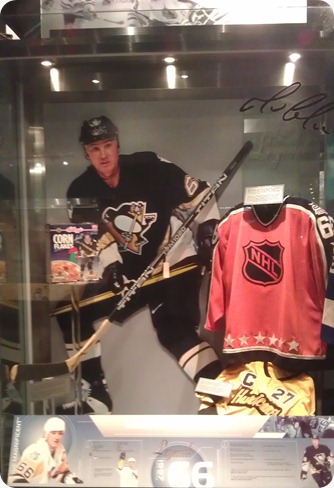
IMAG0220

There were stats and facts and a signature and jerseys and a stick and even a box of Corn Flakes with Mario on the front. There were similar displays for Wayne Gretzky, Bobby Orr, Denis Potvin, Luc Robitaille, Roger Neilson, Ace Bailey (which included one of his golf clubs (?)), Borje Salming, and a bunch of others. There was a computer listing just about every town in Canada; you could select a town and find out what NHL players were born there. Guess who's from Waterdown? Well, nobody. But I grew up in Pickering, Ontario, home of both Glenn Healy and... um, nobody else. OK, I guess I can admit it. I am from the same town as everyone's favourite hockey douchebag, Sean Avery. We even went to the same high school, though he would have started at least five years after I graduated.

There is also a large section of the Hall for international hockey, including the Canada Cup, the Summit Series, various IIHF tournaments, and the Olympics. There are jerseys from just about every country – did you know Ireland had a team? Greece? Mexico? South Africa? Canada won four hockey gold medals in a row at the Olympics from 1920 to 1932, but would you believe their streak was broken by none other than Great Britain in 1936 – the most recent of only two hockey medals Britain has ever won?

One thing that surprised me about my visit to the Hall is the number of mistakes I found. Canada didn't win any hockey gold medals from 1952 until 2002? That can't be right. Seriously though, thinking back to all the places I've visited including castles in the UK, various chateaux in France, museums and other touristy things in London, Edinburgh, Paris, New York City, Boston, Chicago, Las Vegas, San Francisco, Vancouver, Toronto, and others, the number of mistakes I found was zero just about everywhere. I'm sure I've seen errors but I can't think of any offhand, and I'm sure I'd have remembered if there were more than one in the same place. At the HHOF, I found at least four in the couple of hours I was there.

In the same room as the Stanley Cup was a big timeline, listing all kinds of events relating to the NHL. The timeline included not only dates of NHL events, but birthdates of future NHL stars, like this one:

Ken Dryden error

Winning the Cup first and the Calder second is a pretty impressive feat, but doing them 55 years apart is even better. This next one contains two mistakes:

FoxTrax

The first mistake is not so much a factual error as one of punctuation ("it's" should be "its"). The second mistake was FoxTrax itself.

There was a display of the "lucky loonie" from the Salt Lake City Olympics, although in the middle of the description they spelled the word "looine". I'm sure my dad pointed another one out to me but I forget what it was.

On a somewhat related note, there are also the misspellings on the Stanley Cup itself – a number of players have their names spelled wrong, and there's even one team spelled wrong (Leafs is spelled "Leaes" in one place). Former Oilers owner Peter Pocklington famously put his father in the list of people to have their names engraved on the Cup, and when this was discovered his father's name was X'ed out.

Anyway, as I said the HHOF is a must-see for any hockey fan. There are the trophies and memorabilia and lots of information and stats, a couple of short movies, and some simulation games for the kids – two where you are taking shots on a net, one where you are standing in a net where real pucks are flying at you (similar to the commercial below), and one where you're standing in front of a virtual net trying to react to virtual pucks. There's even a section on collectibles and NHL branded products – hockey cards, toys, lunchboxes, bobbleheads, cereal boxes, stuff like that.

My dad and I spent two or three hours in the Hall. QA issues aside, it's quite the interesting place, and when combined with dinner at the Marché upstairs and a Rock game after that, made for a fun day.

HHOF TV commercial

Thursday, January 05, 2012

The best lacrosse writers in the world... and me

I announced back in August that I was joining In Lax We Trust as a writer, and ended up as co-manager and editor as well. I enjoyed my time at ILWT and wrote lots of articles. A few of them got lots of attention: one on lacrosse players' salaries from November is still getting talked about. Some I really liked and had fun writing: a satirical one about what the "future" of the NLL might have looked like in 2002, an imagined conversation among GMs at the entry draft, and some fictional movies about lacrosse.

In December I made the decision to strike out on my own, and created my own lacrosse blog, nllchatter.com. Around that time, I jokingly asked Teddy Jenner if they were hiring at ILIndoor.com, which is part of Inside Lacrosse magazine, and is pretty much the premiere indoor lacrosse blog anywhere. Rather than the expected "yeah, right", Teddy told me to email Bob Chavez. I don't know if Teddy was saying "That's a great idea! Email Bob!" or if it was Teddy's way of getting Bob to say "no" rather than doing it himself. I thought "what the hell, the worst they can do is say no", and emailed him. He got back to me with a proposal, and now I can announce that I will be joining the staff at ILIndoor.com and will be writing a weekly column called The Moneyballers this season. My column will run every Monday starting on January 16.

ILIndoor.com has some of best-known names in indoor lacrosse, including the aforementioned Teddy Jenner, a former player and current blogger, radio show host, and in-game announcer for the Washington Stealth; Ty Pilson, sports editor for the Calgary Sun and former Tom Borrelli winner (that's the NLL's award for the best writer of the year); Brian Shanahan, another former NLL player who has done colour for many lacrosse TV broadcasts (and yes, he's Brendan's brother); Marty O'Neill, the former GM of the Minnesota Swarm; and other great writers like Bob Chavez, Stephen Stamp and Casey Vock.

The Moneyballers will be a weekly look at the clutch players in the league from a statistical point of view. We have a system that assigns points to players for goals and assists that either tie a game or put their team ahead. Goals later in the game count for more than goals earlier, and OT goals count the most. Each week, I will tally up the points for that week's games, and keep track of the league leaders as the season goes on. Here's a link to last year's season-ending article.

I am very excited about this opportunity, but very nervous as well. The Moneyballers is a series that has been on ILIndoor.com for a few years, and up to this year, was written by another legendary lacrosse writer, Paul Tutka. Tutka won three straight Tom Borrelli awards, so that's a pretty tough act to follow. However, I am up to the challenge. But if you call me on a Sunday evening during NLL season, don't expect me to answer the phone.

Thursday, September 22, 2011

Three and one from the Jays game

Quick post about the Blue Jays game I went to with my dad the other day. Three weird things and one complaint – a complaint about complaints.

Weird thing #1: At one point, the Angels had back-to-back doubles, with no outs or stupid baserunning plays in between, and nobody scored. How do you hit a double with a guy on second and not drive him in? Glad you asked. The second double was a popup a mile high to the right side, so the runner on second had to wait to see if it would be caught. The batter, of course, just kept running. When it fell in front of Bautista and behind Lind and Johnson, the runner on second only had time to make it to third but the batter made it to second. Nobody blew the play so it wasn't an error, so the scorer had no choice but to credit the batter with a double. I'm sure it's not unique in the world of baseball, but with your standard double, you can usually assume that all the runners will move up at least two bases, and a baserunner scoring from first on a double is not unusual at all.

Weird thing #2: During Eric Thames' third at-bat, the scoreboard showed that he'd flied out to LF in his first at-bat then flied out to CF in his second at-bat, so my dad and I decided that he should hit it to RF this time. I said "Put it over the right field fence!". Thames hit the very next pitch over the right field fence.

Weird thing #3: "Batting ninth, the designated hitter, David Cooper." The DH hitting 9th? Does someone not understand the concept of the DH? Yes I know: end of the season, the team is out of the playoffs, give the young kids some at-bats, and all that. Still weird.

The complaint about complaints involves Vernon Wells. Each time his name was announced, there were both cheers and boos coming from the crowd. The people booing Wells irritated me. Wells played several seasons for the Jays, and in some of those years he was very good and in the rest he was excellent. After one excellent year he was rewarded with a huge contract. Was he worth it? Probably not. But can you blame him for taking it? If someone said to you "We're going to give you $125 million over the next seven years", are you going to ask for less because you don't deserve that much? Not on your life. So he took it and promptly got injured, hitting 20 home runs only once over the next 3 years. Then he returned to form in 2010, hitting .273 with 31 homers. Are these $15-million-a-year numbers? No but again, his inflated salary is not his fault, it's J.P. Ricciardi's. Wells was traded solely because his contract was so big. He never asked to be traded (Roger Clemens) never said he didn't want to play in Toronto (again, Roger Clemens), didn't sign somewhere else as a free agent (where do I start?) and never admitted to not giving his best during games because he wanted to play somewhere else (Vince Carter). I have even heard the tired old line about "now that he's got the big contract, he doesn't have to play hard." I don't buy that for a second.

Any player playing at the major league level has likely been playing baseball all his life because he loves the game. To get to the highest level in the sport, he'd have to have worked hard and excelled in Little League, high school, college, and several levels of minor leagues where he was making very little money. His hard work and determination paid off, and he made it to the majors where he continued to work hard and excel. And I'm supposed to believe that when he gets a huge contract that ensures that he can continue playing at the highest level, he suddenly doesn't bother trying so hard anymore? The previous 20 years have been solely for the unlikely possibility of the huge payday? No. He's been working his ass off and playing as hard as he can his whole life - he doesn't know any other way to play. That refers to any professional athlete, not just baseball players, and not just Vernon Wells. Well, I guess it doesn't apply to Vince Carter.

Hey Vernon, I was clapping for you.

OK, so that wasn't such a quick post.

Saturday, August 13, 2011

Spotlight: Marisa Ingemi

I have no statistics to prove this, but I would guess that there are far fewer women than men seriously interested in professional sports. By "seriously interested", I'm not talking about those who don't mind going to see a game once in a while, and can name some of the teams and superstars of whatever league. My wife could probably pick Sidney Crosby out of a lineup, but wouldn't know Alex Ovechkin from Alex Trebek. No, I'm talking about women who are "real fans". They know all the players and teams. They can look at a trade and give you an informed opinion about it. They can hear about a player being injured and analyze how it might impact the rest of the team. Before you start to compose your email calling me a misogynist, I'm not saying women can't do this, I'm just talking about numbers. There are simply far fewer women than men that are interested in sports to that degree.

So when you hear that the host of the only radio show in the United States dedicated to the sport of lacrosse is female, you may raise an eyebrow. [Correction: One of the only lacrosse radio shows - there is at least one other] When you hear that she also runs the only lacrosse blog of the 300+ blogs in SBNation.com, co-hosts a baseball radio show, covers baseball for two different web sites, and covers hockey for another, you would think she's not only pretty busy, but she knows her sports and is a seasoned sports reporter and writer. But when I tell you that she recently celebrated her 15th birthday, well, you can pick your jaw up from the floor.

Marisa Ingemi is a high school student who lives in the Boston area. Her first interest in sports came in 2007, when she followed her sister's interest in the Boston Red Sox, and jumped on the bandwagon when they won the World Series. She became hooked on baseball, quickly followed by hockey, football, lacrosse, and basketball. Of course, if you're going to be a sports fan, Boston ain't a bad place to be since each of their hockey, baseball, basketball, and football teams have won championships over the last ten years. I live in the Toronto area where other than the Rock, any season your team doesn't completely suck is considered a success.

After the 2008 MLB season, Marisa decided it would be cool to write her own web site, and began writing news for a fake website at home. She soon created a real website, bestbostonsports.com, which only got a few more hits than her fake one, but it got her started. She started following the NLL during the 2010 season and in an attempt to learn even more about the league, she started looking for lacrosse blogs. She couldn't find one that contained as much information as she wanted so she created her own, simply called The Lacrosse Blog. A few months later, the blog was moved to SBNation.com, becoming the first lacrosse blog in that group, and she renamed it In Lax We Trust. Over 1000 stories and 50,000 page views later, it is one of the most popular fan-run lacrosse blogs on the internet. [Full disclosure: I am one of the eleven writers on that site.]

But just one blog wasn't enough for Marisa. She also covers the Pawtucket Red Sox, Portland Sea Dogs, and Lowell Spinners (all minor-league affiliates of the Boston Red Sox) for both bostonsportsthenandnow.com and minorleagueball.com, and the Boston Bruins for Inside Hockey. She began her radio career in March 2011 with the creation of two different weekly internet radio shows: Lax Live and Beantown Breakdown. Beantown Breakdown features Marisa and a few other local bloggers talking about all aspects of pro sports in the Boston area while Lax Live is covers all types of lacrosse. But Lax Live isn't just some fan yakking about lacrosse for 20 minutes; she interviews lacrosse reporters, bloggers, players, and coaches. She's talked to such names as Andrew McKay, Connor Wilson, Teddy Jenner, Graeme Perrow (had to throw that in there), Dave Pym, John Tavares, Lewis Ratcliff, Ryan Benesch, and even NLL Commissioner George Daniel. Very few 15-year-olds even have a career highlight, but Marisa does, and it's pretty cool: her first-ever interview was lacrosse legend Casey Powell after a Blazers game in 2011.

Considering she's only been following the NLL for two years, Marisa is surprisingly knowledgeable. Ask her who the top goalie in the NLL is, and she'll tell you (hint: it won't be Chris Levis). Ask her who won the recent Brodie Merrill-for-Athan Iannucci trade, and she'll tell you who and why (hint: she'll say Edmonton and she's right). She's interviewed some big names in lacrosse and doesn't sound all star-struck (none of this "OMG OMG OMG I'm talking to John Tavares! He's awesome!!!!!1!") and asks real questions that show insight. When she interviewed me for Lax Live radio last season, I mentioned that Toronto were having problems on transition, and she asked me if Toronto regretted trading away Ryan Dilks. I had completely forgotten that Dilks came from Toronto, so I was caught off-guard. I managed to sputter out some kind of answer and hopefully didn't sound too silly. Before the interview, she had given me a list of questions she was going to ask but that wasn't one of them, which tells me that when I mentioned Toronto's transition, she thought about the Dilks trade on the fly. Despite being a touch embarrassed (which I know wasn't her intent), I was impressed.

Marisa's ultimate goal is to get a degree in journalism and then cover the Red Sox and Bruins for ESPN. There are thousands of people out there who share similar goals, and a good chunk of them likely have created blogs to get some experience and hone their craft. But I suspect the number of them who write for four different blogs, do two radio shows, and have press passes for the NHL, NLL, and minor league baseball years before even finishing high school is much lower.

Perhaps this article will be the first of many to cover this up-and-coming sports reporter. Hopefully she remembers me when she's rich and famous.

Thursday, August 04, 2011

My new gig as a sports writer

No, I'm not leaving the software industry to become an ink-stained wretch, but I will be writing for a bigger audience during the next NLL season. I started writing for the NLL Blog just before last season, and enjoyed being part of that team. Today we are announcing that the NLL Blog staff will be joining In Lax We Trust, one of the most popular lacrosse blogs around. It is run by Marisa Ingemi and features articles on not only the NLL, but the MLL, Canadian summer leagues (MSL, WLA), as well as the new CLax and NALL leagues and some college lacrosse stuff as well. There are now eleven writers for ILWT, myself included.

I will remained focused on the NLL and the Toronto Rock in particular, and I have also decided not to post each lacrosse article here as well. I may post links to the ILWT articles I write, or maybe a weekly digest of my ILWT articles, but for those readers of mine who are not lacrosse fans, fear not. Next winter, you won't get deluged with lacrosse articles like last year, just my regular drivel compelling reading.

Wednesday, July 27, 2011

Baseball is awesome too

A while ago I wrote an article listing some awesome things about lacrosse. I love baseball too, so here are some things that make baseball awesome. Some of these are about playing, some are about watching, and some are just about the game in general.

The opposing team has the bases loaded and nobody out and you get out of the inning without giving up any runs.

When playing the outfield, that feeling you get after thinking "Oh crap, I'm not going to get to this fly ball" and then realizing that you can.

Watching one of your favourite players hit a walk-off 3-run home run to left field to win the World Series. (Note: may not be awesome to Phillies fans.)

An outfield assist.

Weird scoring plays. The best are the ones that involve a rundown. Combine this with the outfield assist, and you could have a 7-6-5-4-5-4 double play.

Seeing a ball game in a park you've never been to before. Places I've seen baseball games: Skydome Rogers Centre, Exhibition Stadium (RIP), Fenway, (New) Comiskey, Alameda County Coliseum (Oakland), The Kingdome (formerly in Seattle - RIP), plus one spring training game in Fort Myers, Florida.

No lead is safe. If you're down 5-0 with 5 minutes left to play in a hockey game, it's technically possible that you could come back and win, but I doubt it's ever happened in the NHL. In baseball, there's no time limits, so as long as you keep getting on base, you can do it. I've seen the Jays come back and win after being down 10-0. The other night I saw them lose 5-4 after going into the bottom of the 9th up 4-0.

Again when playing the outfield, running in on a short pop fly that nobody thinks you can get to, making the catch, and then doubling a runner off. (This has only happened to me a couple of times but is especially awesome since I don't have a strong throwing arm, so baserunners who test my arm generally win.)

When a pitcher strikes out the last batter of a complete game victory. I love complete games in general, but when the last out is a strikeout, you can tell that the pitcher is still in command after nine innings.

A perfectly executed double steal.

When the ball is hit so sharply to the right fielder that he throws the batter out at first. I'm not sure I've ever seen this in an MLB game, but it's happened a couple of times in games I've played in.

Watching a milestone happen live. Doesn't need to be a huge milestone, but when the PA announcer comes on and tells you that you've just seen the first-ever <something>, that's awesome. My wife was in attendance at Dave Steib's no-hitter in Cleveland, but those kinds of milestones are few and far between. Milestones I have seen live:

  • The Blue Jays' first triple play in 1977
  • Manny Lee's first major league hit (a single)
  • Dave Steib's first one-hitter
  • Pat Hentgen's last start as a Blue Jay
  • Roger Clemens' first start as a Blue Jay (and his opening day start the next year too)
  • Cal Ripken's first game after ending his 17-year streak

Seeing a kid bring his glove to an MLB game. It's the only sport where nobody thinks twice if they see you bring your own equipment to a game you're watching. Nobody brings a hockey stick to an NHL game or their own tennis racquet to Wimbledon. I must say I have seen lacrosse sticks at NLL games, but it's generally young kids bringing little plastic sticks, not adults bringing full-sized ones.

A straight steal of home. You gotta have cojones.

When a batter watches strike three go by and then smiles because he knows it was a great pitch.

Watching the last out of the last game of the World Series. I love watching the players celebrate, even if it's not my team. Though it's better if it is.

Did I miss any?

Saturday, July 16, 2011

Bleacher Report's dumbest list ever

The other day I read an article on Bleacher Report by a guy named Shawn McPartlin about the 50 most overrated baseball players of all time. Now, I understand that different people are going to have different opinions on a player's value and whether he's overrated or not. People's definition of "overrated" may also differ. But some of these choices are either misguided or just plain wrong and the whole article ends up as a complete joke.

Some of the choices for this list are a little weird. For example, everyone knows about Brady Anderson's 50-HR season but nobody thinks that was normal for him, so I wouldn't call him overrated. Nobody except the most die-hard (and delusional) Yankees or A's fan thinks of Scott Brosius as anything other than a pretty decent 3rd baseman. McPartlin specifically says that Lou Brock "belongs in the Hall of Fame", so how can he be overrated? In addition, we all know that Brock is in there primarily because of his outstanding base stealing ability – nobody thinks it was because of the hundreds of home runs he didn't hit. Who thinks of Omar Vizquel or Ozzie Smith as anything other than excellent defensive shortstops? Joe Carter was a good player, a good hitter, and a good guy who had one outstanding and unforgettable at-bat, but nobody would list him among the greats, so calling him overrated is unfair – and I'm a Blue Jay fan, the most likely to put Carter on a pedestal.

Dave Stewart won 20 games four years in a row (from 1987 to 1990), and then never won more than 12 in a season after that. McPartlin says of Stewart, "Consistency makes you a great player. Glimpses of greatness makes you overrated." Nonsense. Glimpses of greatness makes you a good player who had, well, glimpses of greatness. If people latch onto those glimpses and think your whole career was like that, that is overrated. Overrated refers to how you are rated, i.e. how people remember you. If people were to think about Dave Stewart as the most dominant pitcher of the 80's and 90's, then yes, he would be overrated. He was very good, and maybe one of the most dominant pitchers of those four years, but anything more than that is a stretch. But who thinks of Stewart as anything more than that? Nobody I know.

The listing of Nolan Ryan as the most overrated player of all time is just funny. If you get to 3,000 strikeouts in your career, you're almost a lock for the hall of fame, and here's a guy with well over 5,000, almost 1,000 more than second place. He won over 300 games, was an All-Star 8 times, and threw seven no-hitters. He was a first-ballot Hall of Famer. He averaged better than a strikeout per inning over his 27-year career. He struck out 301 batters in 1989 when he was 42 – only three pitchers have beaten that total in the 21 years since (Curt Schilling, Pedro Martinez, and Randy Johnson). And McPartlin's argument that he's the most overrated player of all time is that he only won 20 games twice? He's not known for being the best pitcher ever, he's known for being the best strikeout pitcher ever.

We need to decide what "overrated" really means. The way I think about it is as follows: if you asked someone to list the best baseball players of all time in order of overall greatness and a player that you deem to be around #50 is on their list as #30, they they have overrated that player in your opinion. For a player to be generally considered overrated, he would have to show up on most people's lists higher than he really deserves. But who decides where he deserves to be? You also need to ask why a particular player is where he is on someone's list. If someone lists Lou Brock high because he had 3,000 hits and a zillion stolen bases, then the fact that he didn't hit 500 home runs is irrelevant.

Obviously nobody keeps an ordered list of the best baseball players and there isn't a canonical list to compare with, so you can't decide whether someone's overrated based solely on a numerical comparison. You have to look at how people in general think about a particular player in general and subjective terms. McPartlin says:

Some players reach greatness, while others fall short of the hype.

Some players have mediocre careers, but are talked about for decades because of their postseason exploits. 

Some players were so gifted in one facet of the game that their shortcomings are overlooked.

Whatever the reason is, all sports have these players—the overrated ones.

The first one I completely agree with. The kid who comes up from the majors and is touted as "the next great shortstop / catcher / base stealer / home run hitter" and turns into a decent player but not a star is definitely overrated (or more accurately, was overrated). The second and third cases are more iffy and depend on who you're talking to and how the player is described. Wade Boggs comes to mind – he was an incredible hitter, one of the best hitters ever to play the game. He was a good defensive third baseman, had a bit of power, and no base speed to speak of, and if everyone remembered him as "one of the best players ever" or even "one of the best third basemen ever", then yes, he would be overrated. But nobody does. Anyone who saw Boggs play remembers him as one of the best hitters ever. Nobody has ever called him a five-tool player. Does his batting average make up for his lack of power and speed? That's a matter of opinion, but I think it does.

He also lists a number of players who have tested positive for (or admitted to using) steroids, as if that immediately makes the player overrated. I'm no fan of steroids or steroid users either, but let's be fair. Would Jose Canseco have hit 40 HRs three times if he had never taken steroids? We'll never know but assuming he wouldn't is unfair. Similarly, to simply dismiss Ken Caminiti, Jason Giambi, Sammy Sosa, and Mark McGwire as overrated solely because they took PEDs is unfair. And considering this obvious bias, it's odd that neither Roger Clemens nor Barry Bonds shows up on his list. Perhaps that's because he decided (correctly) that they were two of the best players in the history of the game and were Hall-of-Famers before they ever touched steroids. The fact that the last number of years of their careers were chemically-enhanced doesn't take away from the first decade or so when they were clean.

The take-home message, Mr. McPartlin, is that you can't call someone "overrated" just because he wasn't a five-tool player. Yes, some players are well known for being great at only one facet of the game, and the other facets weren't that great. Some players are well known for a single season or even a single event, and the rest of their career wasn't any big deal. Whether or not they are "overrated" depends on how people remember them. If people thought of Joe Carter as the greatest outfielder the Jays ever had simply because of that one home run, then I'd agree that he's overrated. But even Jays fans don't think of him that way – they rate him as a pretty good power-hitting outfielder / 1st baseman who happened to hit the most important home run in Jays history. That doesn't make him overrated.

Having said all that, I can't disagree with including Vernon Wells on the list.

Saturday, June 11, 2011

And Dustin Pedroia is short

I went with my dad to the Jays/Red Sox game tonight. Four observations:

  1. Clay Buchholz is the slowest pitcher in the history of the world. I'm sure he waited ten or fifteen minutes between pitches.
  2. Rajai Davis doesn't have anywhere near the outfield range of Vernon Wells. One inning, a ball dropped in front of him and took a high bounce. Davis jumped and cut it off before it went to the wall, keeping the batter to a single instead of at least a double. Pretty nice play, but Wells would have caught it.
  3. Kevin Youkilis has unbelievable bat speed.
  4. Food and beer at Rogers Centre is really expensive. One hot dog and two small Keith's: $21. Instead of a $5.25 hot dog in the stadium, have a $5 Italian sausage outside the stadium beforehand. Bigger, thicker, tastier, and cheaper.

Sunday, May 22, 2011

Replacing a Legend

(Originally posted on The NLL Blog)

How do you replace a legend, and one of the best players ever to play the game? We don't know much at this point about what changes Terry Sanderson and Troy Cordingley might be considering for the Toronto Rock this offseason, but one thing's for sure – they need a new #1 goaltender to replace the retiring Bob Watson, the only #1 goalie the Rock have ever had. How do you replace someone like Watson?

With all due respect to Pat Campbell, he'll be 35 next year and has been a solid backup goalie most of his career, so I don't see the Rock tossing him the keys to the franchise. The Rock have had a definite #1 goalie for their entire history so I don't see them going the route that the Bandits and Stealth have used – having two main goalies and "platooning" them (to steal a baseball phrase), so going with both Campbell and Gee Nash is unlikely as well.

Not going with Campbell or Nash means they will have to try to acquire someone from another team. I don't have of a list of goalies who are free agents this summer, so let's ignore that route for the moment and just assume we're talking trade. The top goalie on the "would be nice" list would have to be back-to-back Goaltender of the Year Matt Vinc. Suuuuuure. The Knighthawks gave up John Grant for this guy so unless we offer Doyle, LeBlanc, and a few prospects, he's not going anywhere – and definitely not to a division rival. Mike Thompson? Suuuuuure. Thompson is coming off of a fabulous season in which he had the second-lowest GAA and third highest save percentage in the league. If Ken Montour is able to return from his injury, the Bandits may consider trading Thompson, but Stephen Stamp's article about concussions didn't give much reason for optimism there. I hope I'm wrong about that. Brandon Miller from Philly? Maybe, although he was one of the few bright spots in Philly this season and was the reason they fought for a playoff spot as long as they did. Anthony Cosmo? Possibly – he had the lowest GAA in the league last year though I wouldn't call it one of his better seasons. It'd be ironic if Cosmo actually did replace Watson in the Rock net, like we thought he would many years ago. Cosmo himself mentioned that possibility recently in an interview with ILIndoor.com.

Let's look west. How about Poulin from the Roughnecks? That'd be great for the Rock, but why would Calgary do this? Do they want Palidwor as their #1 next year? Not likely. And it's not like the team has some glaring weakness that could be addressed by making a big trade, so file that idea under the "Suuuuuure" category as well. (Not to mention the fact that making roster changes to his lacrosse team is not exactly at the top of Brad Banister's To-Do list these days. Hey Brad, if you're actively trying to sell the team, surely there's a better way to convince some sucker astute business person to buy them than publicly whining about how little support the team gets and how much money you're losing.)

So what about Edmonton? I'm sure they wouldn't mind some extra firepower given that they traded Gavin Prout back to Colorado. But which Edmonton goalie to choose – Matt Disher or Rob Blasdell? Ummmm... no thanks. Chris Levis from Colorado? Another "Suuuuuure". After years of mediocre goaltending the Mammoth finally have a strong #1 so I don't see them trading him, though they could also use some help in the offense department. (Aside: It seems unbelievable that a team that just acquired John Freakin' Grant still needs help on offense.) How about Washington? I didn't think Tyler Richards had that great a 2011 season, but he was certainly the second-best goalie in the playoffs. But how likely are the Stealth to trade him to the team that beat them in the finals? Similar to Calgary, they're a strong team to begin with, so what could we offer the Stealth for them to give up Richards? Would Minnesota give up Patterson? I doubt it, though I know nothing about Kevin Croswell – if they have enough confidence in him, maybe they would if they got enough in return. That's a team that should have made big changes in the off-season last year and didn't, so perhaps a big shake-up would be good for the Swarm.

There are lots of possibilities here, some of which I can't address properly because I don't know much about the backup goaltenders. Philadelphia backup goalie, Ray Hodgkinson, is only 23 and only played 46 minutes this year. But maybe the Wings think this kid is the next Dallas Eliuk – if they have enough confidence in him, maybe they would give up Miller for the right price. Hell, for all I know the Rock have some young goalie in their system (is there such a thing as a "system" in the NLL? It's not like there are AAA affiliates like in baseball, or the OHL/AHL like in hockey) that is the heir apparent, though I've never heard mention of one.

So we have a few "maybe"s and a few "not bloody likely"s, but there aren't really any "no chance in hell"s. (In a league where Gary Gait can be traded three years after retiring, nothing's impossible.) But trades run two ways – the other question would be "Who could the Rock give up to get a #1 goalie"? Doyle, LeBlanc, and Billings are untouchables. Blaine Manning is a possibility, or maybe a rookie with potential like Aaron Pascas or Rob Hellyer. (Or more likely, the combination of a Pascas and a veteran like Manning or Cam Woods.) It's not unlikely that a team trading away a goaltender may want defense in return rather than a goal scorer, so perhaps 2010 NLL Defender of the Year Sandy Chapman (though I'd prefer if he were untouchable as well), or hard workers that get little fanfare like Drew Petkoff, Jeff Gilbert, or Creighton Reid.

Trade speculation is fun but ultimately pointless, as there are a zillion factors that we as fans don't know about that affect whether deals can be made. Are there no-trade contracts in the NLL? If not, could there be "gentlemen's agreements" between players and GMs that effectively mean the same thing? Are there personality conflicts between players or between a player and a GM that mean that some trades are impossible? Are there players who might simply refuse to be traded? Since this is a part-time semi-pro league, it's certainly possible that a player may decide that travelling across the country for the majority of games is just too difficult with work or family commitments, and would prefer to retire than be traded to a team on the other side of the continent. I remember a rumour that the Rock were not allowed to trade Dan Ladouceur because of his position with the Durham Region Police.

So after all that, here's the net result of this discussion:

  1. The Rock need a new #1 goalie.
  2. I don't know who they should get.
  3. I don't know who they should give up to get him.

My work here is done. This is why the NLL Blog pays me what they pay me.

Wednesday, May 18, 2011

A Momentary Lapse of Reason

(Originally posted on The NLL Blog)

As I mentioned in my write-up on the Championship game, the reffing was pretty good on the whole, with the exception of one notable play. There were no significant in-game repercussions of this play, and I don't know if there will be any coming, but their certainly could be. The player in question certainly needs to take responsibility for what happened, but I think that a big mistake was made by the ref and without that mistake, the whole incident could have been prevented.

It's near the end of the first quarter, and the Rock are up 3-1. They have possession in their own end, but are having trouble getting the ball out. Just before Blaine Manning crosses the centre line, the ref blows the whistle for a 10-second violation. Everyone on the floor stops, and Manning turns around and heads towards the bench, still holding the ball in his stick. Kyle Sorensen must not have heard the whistle and ran from well beyond his own restraining line towards centre, and knocks Manning down while trying to get the ball out of his stick. This must have been at least five seconds after the whistle. It's not like he hit Manning overly hard, but Manning certainly wasn't expecting it since play had long since been whistled dead.

At this point, several players from each team approached the centre circle where this was happening and there were a couple of shoves. This is when the mistake happened. For some reason the ref, standing less than ten feet away from the scuffle, blew the whistle to start play. Kyle Ross immediately cross-checked Sorensen in either the neck or head, and Sorensen dropped like a rock (no pun intended). The ref blew the play dead again, there was a little more shoving, and Ross was sent to the box for five minutes. Sorensen remained on the ground for several minutes before being helped back to the bench by the trainer. He remained in the game. (For those fans sitting near me calling for a diving penalty, watch the replay and then STFU.) At the same time, the Stealth were given a too-many-men penalty.

I have three questions about this play:

  1. Perhaps Sorensen didn't hear the whistle, but did he not wonder why none of his teammates were going after Manning – or moving at all? Manning was not looking at the defenders, and was walking slowly back towards the centre line, neither of which he would do if the play wasn't dead. So why did Sorensen run so far to go after him? Did he really think that the ball was live?
  2. Sorensen hit Manning before the whistle (i.e. while play was dead), and then a small scuffle began. Why did the ref blow the whistle to start play at that point? Why not wait until things had calmed down a bit?
  3. If the Stealth were getting a penalty (too many men), why did the ref begin play at all? Possible answer: Another ref was about to call the bench minor and didn't blow his whistle because the play was dead anyway.

For me, number 2 above is the biggest question. Ross waited until the whistle was blown before he hit Sorensen. If the ref had not blown the whistle, would he have hit Sorensen at all? Obviously there's no way to know, but instead he's in the box for five, and could have been thrown out of the game. In addition, there may even be other repercussions (i.e. a suspension) for this blatant hit to the head. Sorensen was down for a long time and if there was a concussion involved, he may not even know about it for a few days.

It's amazing what one little mistake in judgement can lead to.

One slip, and down the hole we fall.

Monday, May 16, 2011

The Toronto Rock are the 2011 NLL Champions

(Originally posted on The NLL Blog)

The ending to Bob Watson's incredible NLL career couldn't have been scripted any better. Not only did he win his sixth championship with the Toronto Rock after an 8-7 victory over the Washington Stealth, but he was named game MVP for the second time in his career. And this was no "it's his last game, let's just give him the game MVP" thing, he deserved that puppy. Watson put on a goaltending clinic in his last-ever game, stopping 46 of 53 shots and keeping the most potent offense in the league to just 7 goals. Tyler Richards played a great game in the opposing goal, keeping the third-most potent offense in the league to only 8 goals, and only one in the entire second half. This was a strong defensive battle on both sides, especially considering the offensive firepower of both of these teams.

Rookie defender Glen Bryan of the Rock opened the scoring less than two minutes into the game, thereby doubling his career goals total. Cliff Smith answered a few minutes later, with a weak shot that went over Watson's right shoulder. Watson looked quite awkward on the play, but then he and the Rock defense shut the door, not allowing another goal until twelve minutes into the second quarter. "The defense was Rock-solid!" said my eleven-year-old son Ryan, very proud of his pun. Both teams played excellent defense as I said, and many of the 50+ shots taken by each team either hit the goalie square in the chest, or occurred with a second left on the shot clock.

The Rock D kept the pressure on the entire first half, and the Stealth forwards started to make mistakes when they realized their game plan wasn't working. When the Stealth did manage to get a decent shot off, Watson closed the door. Lewis Ratcliff was denied on one of Watson's brilliant saves and when the ball ricocheted into the crowd, Ratcliff simply stopped and looked at the floor, frustration written all over his body.

On Teddy Jenner's Off-The-Crossebar podcast last week, Rhys Duch said that they couldn't afford to let the Rock get off to a big lead early: "If we're going to spot Toronto a 5-1 lead like we did Minnesota, that's a hole we might not be able to dig ourselves out of". Duch was more accurate with that statement that he likely wanted to be. The Rock led 6-1 late in the second and 7-2 at the half. In Stephen Stamp's live blog of the game, he even used the word "blowout". That said however, everyone in both the Rock and Stealth dressing rooms (and I suspect many fans in the building) remembers the seven goals the Stealth scored in the 4th quarter of last year's final on their way to a comeback victory. At halftime, despite the five goal differential, nobody thinks this game is over.

The second half was more of the same at the Rock's end of the floor. Solid defense, frustrated Washington offense, and brilliant goaltending. The Stealth did start to put things together though, scoring two in the third and three in the fourth to get back to within one – while at the other end of the floor, Tyler Richards was more than doing his part and making his own bid for game MVP, keeping the Rock scoreless in the third and only allowing one in the fourth. As the Stealth slowly climbed their way back into the game, the crowd got quieter and quieter, praying they weren't about to witness a repeat of last year. But as Whipper and the D continued to stone the Stealth forwards, the clock continued to wind down.

As an aside, "Whipper and the D" would be a good name for a rock band.

The Stealth got within one at 7-6, then Stephan Leblanc put the Rock up by two once again. But just thirteen seconds later, Paul Rabil got the Stealth back to within one with an absolutely blistering shot. Rabil was circling around the offensive zone when there was only a second or two left on the shot clock. He turned towards the net and fired, while still running, what might have been the hardest shot I've ever seen. The shot hit Watson so hard it knocked him down and then trickled underneath him across the line. An unbelievable goal. Rabil's shot has been clocked at over 110 mph, so for all of you who laugh at the amount of padding lacrosse goalies wear, that's why.

In the end, despite the strong play of Richards as well as Paul Rabil, Mike Grimes, and the Stealth D, the offense just couldn't get it done. When Cam Woods picked up a loose ball with 15 seconds left, he did not shoot at the open net but just burned the clock until the horn sounded, and then joined his teammates in mobbing Watson.

Once the handshakes had been done, many of the Stealth players remained on the floor to watch the Cup presentation ceremony, and even applauded when Bob Watson approached the podium. They were given a well-deserved ovation by the crowd after a strong season and a great game. It was no surprise that Watson was named game MVP, as he was in 2002. There was really nobody else that could have been game MVP – the Rock played very well as a team but nobody other than Watson really stood out. (If I had to choose second-place, I might go with Kasey Beirnes.) After Watson thanked Commissioner George Daniel and the crowd, Daniel told Colin Doyle to come up for the presentation of the Champion's Cup, but Doyle sent veterans Cam Woods and Kasey Beirnes up to get it. (Daniel later tweeted "Colin threw me a curve ball with that classy move...") Woods and Biernes had each played ten-plus years in the NLL with no championships, so this was indeed a classy move by Doyle, a six-time Champion. After Biernes gave Doyle the Cup, he gave it to Watson, who got the biggest ovation of all.

The Rock are now tied with the Philadelphia Wings with six championships each. But if you only consider the NLL itself (not the MILL or Eagle Pro leagues), the Rock have won three times as many championships as anyone else, since no other team has won more than two since 1998.

After the game, a bunch of us went for dinner at Fran's Restaurant. On our way back to Union Station to catch the train home, we were crossing Yonge at Front when we heard someone yelling "Yeah Rock! Wooooooooooo!" (Note that this was close to three hours after the game ended.) An SUV drove by (going south on Yonge) with the windows down – they must have seen a few of us with our Rock jerseys. I didn't see the driver, but there was a smiling man in the front seat, and another very excited man in the back seat with his head and right arm out the window who was waving at us and still yelling "Wooooooo!" We laughed and waved as Troy Cordingley (in the back) and John Lovell (in the front) continued on their way to the next victory party.

Other game notes:

  • Paul Rabil was all over the floor, and did a great job killing time while the Stealth were down by two men.
  • The refs stayed out of it for the most part – no really stupid penalties were called, though I think one ref made a big mistake at the end of the first quarter that could have caused a severe injury to Kyle Sorensen and may result in a suspension to Kyle Ross. I'm going to write about that in a separate posting.
  • The Rock were hitting posts and crossbars all over the place. Kasey Beirnes took a shot in the second quarter that hit the right post, the left post, and Richards' back but it still managed to bounce out.
  • If you recorded the game or get a chance to see it on the NLL network, go to the 11:05 mark of the second quarter (i.e. 11:05 left in the quarter). You will see Bob Watson make one of the best lacrosse saves you will ever see. As Stephen Stamp said, "He doesn’t look like a man who's half a game away from retiring."
  • The Stealth were given an interesting too-many-men penalty in the first quarter. Usually "too many men" refers to a player leaving the bench just a little early and getting involved in the play before his counterpart leaves the floor. In this case, the Stealth actually had six attackers out on the floor, none of them within twenty feet of the bench. Oops. The crowd noticed this long before the refs did, and a number of people near me were yelling "too many men!" before the whistle was blown.
  • The Rock have really gotten into this Air Gait thing lately. For a while they were illegal, and then the rules were changed a couple of years ago. Since then they have been fairly rare, but in the last few Rock games, there have been several attempts (many successful!) at these leaps from behind the net. There was another attempt by Colin Doyle in this game, though it was disallowed because Doyle was touching the line when he jumped. Actually, since the goal was immediately waved off and there was a review, it's more accurate to say that there was no evidence that he wasn't touching the line.
  • Creighton Reid was given a goaltender interference penalty in the third, which you could describe as "two minutes for not knowing what to do when you're in the offensive zone". He took a shot which was trapped on the ground by Richards, but then he hit Richards' stick with his own. As soon as he did it, he had this look like "Oh crap, I don't think you can do that." But how often has Reid even seen the other side of the centre line? I'm sure he'll remember next time.
  • Garrett Billings scored a beautiful over-the-shoulder goal near the end of the second. While standing slightly to Richards' left with his back to the goalie, he looked over his left shoulder and then fired the shot over his right.
  • The attendance at the game was 14,488. I was sure I read on Twitter through the week that over 15,000 tickets had been sold, and the last time a Championship game was held in Toronto, an NLL record was set when over 19,000 showed up. From those points of view, the attendance was a little disappointing, but I think it was also the highest attended game in Toronto in several years, so that's certainly a good thing. Hopefully that carries over into next season.
  • In the Rock's six championships, they have only had three Championship Game MVPs – Doyle won it three times and Whipper twice. The other winner was also in attendance – Stealth assistant coach Dan Stroup won it in 2000. Watson and Doyle are two of only three players who have won the award more than once – Philadelphia legend Dallas Eliuk won it in 1998 and 2001.
  • Interesting stat: Number of League MVP awards won by Gary Gait, Paul Gait, and John Tavares combined: 10. Number of Championship Game MVP awards: 0.

Wednesday, May 11, 2011

Blackout!

(Originally posted on The NLL Blog)

I travelled with my wife and sons to Sault Ste. Marie, Ontario this past weekend for a family thing, which meant that I wasn't able to travel to Buffalo to see the Toronto Rock's victory over the Buffalo Bandits. I knew the game was being televised on TSN2, so I was hopeful that I would be able to watch it at the hotel. I checked in advance and the hotel did have free wifi, so worst case, the hotel doesn't get TSN2 but I'll be able to stream the game over the internet, right? Wrong.

Blackout

When we arrived at the hotel, one of the first things I did was to check to see if they got TSN2. No such luck. We went about our family stuff and after dinner on Saturday, we returned to the hotel where I planned on firing up the ol' laptop to watch the game. I connected to nll.com, clicked "Watch Live" as I have done so many times this season, and waited in anticipation to see the score, since we had missed the first quarter. The game came up, I saw a score of 6-4 Rock, and a second later the screen went blank. A message came up saying something like "The content owner has blocked access from your current location, you LOSER", and it was then I remembered the whole blackout thing. When Rock games are televised on TSN or TSN2, they are generally blacked out in Canada on the NLL Network. I have never really paid much attention to this before, since I am at the home games, and I watch the away games on TV. This time, I'm over nine hours away from HSBC Arena and I can't watch on TV, so the internet is the only option.

I ended up "watching" the game by bringing up the boxscore from NLL.com and hitting Ctrl-R now and again to refresh it. This was less than satisfying so I tweeted NLL Commissioner George Daniel asking why. To his credit, he responded quickly. Here is our short conversation:

@GraemePerrow: . @NLLCommissioner Why is the Toronto/Buffalo game blacked out on NLL.com? It's impossible for me to watch the game any other way

@NLLCommissioner: @GraemePerrow should have only been blacked out if you are in Canada because game was on TSN2

@GraemePerrow: @NLLCommissioner I'm in Sault Ste. Marie ON, in a hotel on the river. I could throw a rock and hit Michigan. My hotel doesn't get TSN2

@NLLCommissioner: @GraemePerrow sorry about that but we did publish the blackout in advance on nll.com.

Mr. Daniel was absolutely right, they did publish the blackout in advance, I just didn't pay attention to it. And the fact that my hotel was a few hundred feet from the American border was irrelevant – they have to draw the line somewhere, and if you're on the wrong side of that line, too bad. (OK, so maybe I couldn't throw a rock from the hotel and hit Michigan. But if I walked down towards the water a little, I could definitely hit the cut-off man.) I suppose I could have driven across the border to Sault Michigan, found a Starbucks with free wifi, and watched the game from there.

But Andrew McKay from The Laxist also chimed in, saying "IMO, shouldn't be blacking out game that's on an opt-in digital channel." But he quickly changed his mind: "actrually [sic] I take it back. Agreement makes sense because TSN does move games to main channel." I was a little disappointed that Andrew had pulled his support for my predicament, and we had the following exchange:

@GraemePerrow: @apmckay IF they move it to the main channel, fine, but otherwise it shouldn't be blacked out

@apmckay: @GraemePerrow yeah but I can see signing blackout rights in return for main channel possibility.

There it is. That's the thing that made me change my mind and see reason. The NLL must have negotiated a deal with TSN that says "All games televised will be blacked out in Canada. In return, the occasional game will be televised on TSN rather than TSN2." I believe that Rock owner Jamie Dawick paid TSN to televise Rock games during the regular season, so I don't know how the regular season blackouts worked. But I did confirm with Mr. Daniel (again, via twitter) that the Championship game rights were negotiated with the league, not the Rock. I would assume that deal included all the playoff series.

So yes, it sucked that I couldn't watch the Rock-Bandits game last weekend, especially since it sounds like it was a great game. (On the upside, I did get to visit the Canadian Bushplane Heritage Centre, which is much more interesting than it sounds.) But in the end, having lacrosse televised (even occasionally) on the most-watched sports network in Canada is worth a little inconvenience.

Tuesday, May 10, 2011

The Transition Player That Wasn't

Last week, Calgary's Jeff Shattler was awarded the 2011 Transition Player of the Year award. There is no question that Shattler had a great season, and I would even list him in the top few MVP candidates. I congratulate him both on his season and this award. But Shattler wasn't a transition player for most of 2011, he was a forward, a significant part of the Roughnecks offense.

According to ILIndoor.com (a couple of typos left intact):

...apparently as long as a player is classified with a “T” by their name (which is done by the team, not league), they can be a contender for the NLL’s Transition Player of the Year Award. Andyone with D or F by their name (defender or forward), no matter what role they appear to be playing during the season, cannot be considered for the honour.

So Shattler was considered a transition player by the league because Calgary listed him as one at the beginning of the season, regardless of how he was actually used. This is silly. Surely the GMs and coaches and whoever else votes on these awards are lacrosse-savvy enough to be able to distinguish which players should be considered based on their play, not based on a letter on the roster list?

If you look at the Toronto Rock roster on nll.com, the only person listed with a "T" by their name is Ryan Sharp, who missed most of the year. Does this mean that nobody on the Rock was even considered for this award? I don't think anyone on the Rock had a Transition Player of the Year type season quite honestly, but to completely disqualify players like Marshall and Chapman and Merrill because the Rock listed them as defenders is silly and unfair.

Whether a player is a "defender" or "transition player" is hard to nail down. Many transition players play a lot of defense as well, and some defenders are involved in transition while others aren't. But as I said, the people voting on the NLL awards know lacrosse. They don't need to be told that Brodie Merrill is a transition guy while Cam Woods is not. They are not going to vote for Colin Doyle for Defender of the Year, and they don't need to look to see if there's a D beside his name to make that decision. Having said that, enough of them did vote for Shattler which is why he got the award. Can't say I understand that.

There were a couple of travesties in the NLL awards this year – Dave Pym should have been a lock for Coach of the Year, and Matt Vinc had a very good season but Mike Thompson's was better. Many people are disagreeing with the choice of Pat McCready as Defensive Player of the Year. No disrespect to Shattler intended, but the league got this one wrong as well.

Tuesday, May 03, 2011

Expanded playoffs in MLB

I read an article in Sports Illustrated by a baseball writer named Joe Sheehan the other day, and after finishing it, I couldn't get to the computer to fire up my blog-writing software fast enough. The article was called "More is Less", and had the following subtitle:

Miss pennant races? Think the regular season should matter? Then an expanded postseason isn't for you.

I was halfway through the first paragraph of the article before I realized that I read what I expected to read, not what was actually there. It said "an expanded postseason isn't for you". I can't imagine how an expanded postseason isn't better for everyone.

Sheehan says that adding an extra wild-card team to the playoffs will "finally destroy any notion that regular-season excellence matters". He illustrates his point with a scenario in which the winner of the second wild-card spot (Team A, in fifth place) has a big lead over the sixth place team and therefore "cruises" into the playoffs, allowing them to rest their starters during the last few games of the season, while the fourth place team (Team B) finishes hard because they're trying to win their division and just fall short. This means that the Team B, who finished ahead of Team A potentially by "10 or 12 games", needs to play a well-rested Team A in the first round and the team that finished lower in the regular season could end up winning that series. I'm not saying that this scenario is not possible, of course it is. But that's what we sports fans call "The Playoffs". I suppose Mr. Sheehan thinks that the fact that the President's Trophy winner rarely wins the Stanley Cup the same year is a failing of the NHL.

The thing is that this scenario could happen even without the wild cards. Say we're back in the days when there was just two divisions in each league, and the winners face off in the League Championship Series. Now say the winner of the weaker East had a 90-72 record but clinched the division with a week left in the season, and the winner of the stronger West finished at 100-62 but didn't clinch over the second-place 99-63 team until the last day. The team with the worse record is well rested and has a big advantage over the exhausted team with the better record.

I hate to tell you this, Mr. Sheehan, but the regular season is the seeding process for the playoffs. Ask any baseball player which they would rather do – have the best record in the regular season, or win the World Series? Any athlete in any sport will tell you that winning the regular season title is meaningless if they don't win the Championship.

Mr. Sheehan came up with a theoretical scenario in which expanding the postseason might negatively affect a team in a particular situation (note that the team that was affected in his scenario did make the playoffs, so a lot of teams might think that's a pretty nice problem to have). But let's look at a real-life scenario – the 2009 American League. On September 1st, the Yankees, Tigers, and Angels were leading their divisions. The Red Sox were 6½ games back in the East (and leading in the wild card race), the Twins were 3½ games back in the Central, and the Rangers were 6 back in the West. None of the races is over, but if there is no wild card spot, the East and West are much less compelling. 6 or 6½ games out with a month left to go is certainly not insurmountable, but even if Boston sweeps a four-game series against New York, they're still 2 back, so a lot would have to happen for the Red Sox to make the playoffs. The Rangers are in the same situation in the west, but nobody else really has a chance in either of those divisions. With a wild card spot, the Red Sox make the playoffs, and Texas and Tampa are only 4 and 5 games out respectively. Right away, you can see that having a wild card race means that excitement in these cities would be much higher – excitement not only for the fans, but for the players as well. More excitement for fans means higher attendance and more TV viewers, which is good for ownership and for baseball in general. More excitement for players means harder-played and likely more exciting games, which further increases fan interest. And that's not just fans in those cities – fans of the other front-running teams will be watching more to see the team they might face in the postseason. I don't see how adding the wild card spot is bad for anyone.

With a second wild card spot, there's still excitement in Boston but now if things stay the same, Texas will make also  the postseason and Tampa is only one game out. The Mariners are 9 games out of the first wild card spot, but only 5 out of the second. More exciting games, more excited fans in more cities, more TV viewers. Once again, everybody wins. Winning the division is still valuable – you make the playoffs and have home field advantage while playing a weaker team.

This doesn't turn MLB into the NHL, where teams barely over .500 make the playoffs (the 2009 Canadiens were 39-33-10) , or even worse – the NBA, where the 37-45 Pacers made the 2011 playoffs. (Of course, I'm a fan of the National Lacrosse League where 80% of the league makes the playoffs, including the 5-11 Minnesota Swarm in 2010. But I digress.) Even with a second wild card spot, only the top five teams in each league (out of 14 or 16) see postseason action.

It is, and should be, possible for a team to lose in the playoffs to a team below them in the regular-season standings. In Mr. Sheehan's view, this makes the regular season meaningless. But what if there were no wild card spot in the 2009 season? The Yankees get a bye (fans love those, don't they? They get to watch their team play fewer playoffs games) while the Twins and Angels play each other. But what if the Twins take out the Angels and then the Yankees? It certainly could happen – weirder things than that have. The Yankees won sixteen more games than the Twins in the regular season but don't go to the World Series. Doesn't this also make the regular season meaningless?

I am a Blue Jays fan, and the Jays haven't played a really meaningful game in September for well over a decade, and this is true for many other teams as well. Maybe the entire regular season isn't meaningless but the last month or so is, for the vast majority of teams. Adding an extra wild card team in each league means that some of these teams have a better chance of making the postseason. They may not be in a Pennant race, but they will be in a playoff race, and for teams that haven't been in an actual Pennant race in years, that's almost as good. September will be more compelling and exciting and therefore meaningful for these teams. Isn't making the regular season meaningful something that you're trying to accomplish?

So Mr. Sheehan, if you want to make sure that the regular season is really meaningful, you'd need to eliminate the divisions entirely and just have the first-place AL team play the first-place NL team in the World Series. The W-L records can't be compared because they play with different rules and against different teams, and so there's none of this worse-record-beats-better-record stuff that you don't like. But you tell the owners that you're reducing the post-season from eight teams and three rounds to two teams and a maximum of seven games and see how they welcome this dramatic drop in playoff revenue. You tell the fans of the fourth- and fifth-place teams that the fact that they didn't make the playoffs is somehow good for baseball. This scheme may be better for the ultra-purists, but not for anyone else.